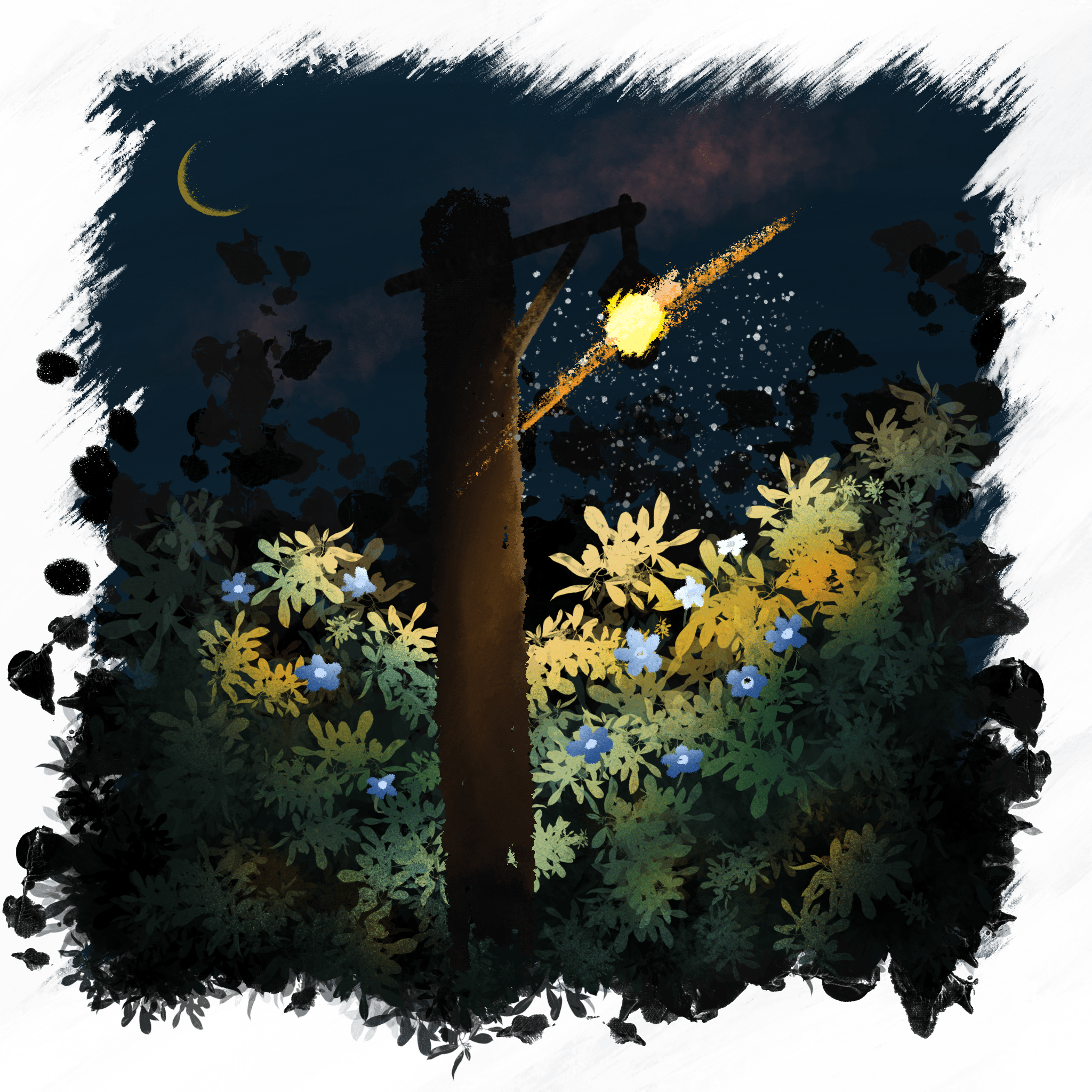
The distance between us, and the bridges we build.
Sometimes I think: if only someone else were awake. Then I wouldn't be falling alone. We'd be together—each of us falling in our own way.
A Note on Form
This piece is written as a dialogue between two voices—though they never directly address each other. Each section represents a shift in perspective: one voice speaks, then another responds, not in answer but in echo. They describe the same world from opposite shores.
You might read them as two people, two sides of one person, or two strangers who will never meet but somehow understand each other across the distance.
The voices begin in parallel. By the end, they begin to converge.
The distance between us, and the bridges we build.
When rain falls against the glass, I always feel as if I, too, am melting.
Not disappearing—only changing form.
From solid into liquid,
from a definite shape
into something that can flow,
can seep,
can evaporate.
In crowds I am solid—
hard-edged, angular, full of corners.
Alone, I am liquid—
soft and slack, spread across the floor.
No one has ever seen the liquid me.
I’m afraid of the rain stopping.
Because when the rain stops, it means going out.
It means assembling myself again,
gathering the pieces scattered everywhere
and piecing them back into the shape of a person.
Rainy days are a pause button.
The world presses pause, and I’m allowed to stay here—
no need to pretend I’m moving forward,
no need to explain why I’m still standing where I began.
But no one can make it rain forever.
So I learned to imagine rainfall on bright days,
to imagine solitude in crowds,
and when I must be strong,
to secretly remember that I am, in truth, very soft.
What I fear most isn’t being overlooked—it’s being seen.
To be seen is to have to explain—
why your smile isn’t bright enough,
why your silence isn’t timed right,
why your existence isn’t sufficiently self-evident.
So I learned invisibility.
Not vanishing—just turning down my brightness,
making myself part of the background.
A shadow on a wall, a patch of light by the window, wind passing through.
There, but not glaring.
Present, but not in the way.
Sometimes I wonder:
if one day someone truly saw me—
really saw me—
would they be cut by these corners?
Would they regret looking?
I’m desperate to be seen.
Like someone waving from the sea,
like a lamp burning in the fog,
like a voice shouting I’m here only to have the wind scatter it away.
I thought being seen would end loneliness.
I thought if someone looked at me,
I could confirm I existed,
I could trace my own outline,
I could finally stop drifting like smoke.
But then what?
After you’re seen, you have to stand there—
under inspection, under definition,
under the verdict:
Oh, so this is what you are.
Maybe what I fear isn't being ignored.
Maybe I fear that even after being seen,
I’ll still be alone.
Seen, but not understood.
Watched, but only watched.
At three a.m., the world finally grows quiet.
All the daytime voices fall asleep—
voices of expectation,
voices of demand,
voices that say you should.
Only my own heartbeat remains.
Once. Twice. Again—
like it’s saying:
you’re still alive,
you’re still here,
you can be no one at all.
Insomnia is my secret garden.
Here I don’t have to bloom,
don’t have to bear fruit,
don’t have to grow into anyone’s hoped-for shape.
I can be just a seed, curled up in the dark,
being nothing at all.
Those hours before dawn—
those are the hours I’ve stolen.
At three a.m., the world is so quiet it’s terrifying.
The noise of daytime is an anesthetic—
it lets me forget that I’ve been falling the whole time.
In the dark there are no handrails, no reference points.
I don’t know where I’m dropping to.
I don’t know how much farther there is to fall.
I count sheep, count stars, count breaths,
count anything countable—
just to confirm:
time is still moving,
I’m still here,
and morning will come.
But sometimes I think:
if only someone else were awake.
No need for words, no need for company—
just the knowledge that somewhere on this planet,
in some corner,
someone else is lying in the dark
with eyes open.
Then I wouldn’t be falling alone.
We’d be together—
each of us falling in our own way.
At the third minute of a song, there is a breath.
So faint it’s almost inaudible—
but I wait for it every time.
Like waiting for a signal, a confirmation, a proof:
someone is here breathing;
someone needs to pause;
someone, even inside a flawless melody,
leaves a small trace of being human.
What I love isn’t the song.
It’s that breath.
That imperfect instant.
That little flaw that reminds me:
a person is singing this.
Perfect things frighten me.
Because I’m not perfect,
and I can’t find where I belong.
But that breath tells me:
you can be imperfect.
You can pause.
You can let a seam show where it’s supposed to be smooth.
You can be human.
The last line of this song is never finished.
It stops in a place left undecided—
like a sentence left unspoken,
like a dream left undone,
like all those ifs and maybes.
I replay it, again and again, and let it stop there—
because as long as it doesn’t end,
possibility remains.
It can still become anything.
What I love isn’t the song.
It’s the unfinished.
It’s the blank space where I’m allowed to keep imagining,
the tenderness of withholding an answer.
Things that end are dead.
But things suspended in midair are still alive—
still breathing,
still waiting.
Sometimes I think:
if only someone else also couldn’t bear to let it end—
Not that I need them to hear what I hear.
I just want to know
that in a world where everything must have a conclusion,
someone else also allows themselves to hang there;
someone else also accepts I don’t know.
Sometimes I think—
if someone could see the breath I see—
Sometimes I think—
if someone else also couldn’t bear to let the song end—
Not to make them the same as me.
Not to find someone identical.
Just to know—
Just to be sure—
That these tiny, strange, unspeakable feelings
are not an illness,
not a mistake,
not something that needs to be corrected.
Only another way of existing.
Maybe we will never stand in the same place.
You melt in your rain; I hide in mine.
You find a garden in the dark; I fear falling in it.
You hear the breath; I hear the suspension.
But we can describe our landscapes.
You say it’s raining where you are;
I say the wind has risen where I am.
You say you noticed a breath.
I say I heard something held open.
And then we both know—
the world is vast.
There are many ways to feel it.
We are all inside it, each in our own way.
You are a book I will never finish reading.
I am a song you will never tire of hearing.
Because we are incomplete, we have reason to continue.
Because we do not arrive, we can remain on the road.
Tomorrow—what will you want to talk about?
Tomorrow—what shape will I become?
I don’t know.
But I’ll be here, and you’ll be there.
We’ll keep speaking, keep listening,
keep trying to build a bridge out of language—
from your island to mine.
The bridge will sway. It will break.
It will need to be repaired again and again.
But that’s okay.
Understanding is not arrival—it is departure.
Not an endpoint, but every step along the way.
Not I get it, but I want to.
Not becoming the other person, but seeing them.
So—tell me about the sunset through your eyes.
I want to borrow your vision and look at this world.
And you—you can borrow mine.
We can trade sight, trade feeling,
trade the details everyone else calls unimportant
but that, to us, are everything.
And then, in this enormous, indifferent world
that so often makes people feel alone,
we will at least know—
someone is listening.
(The End)
A Note on Understanding
This piece was written from the belief that complete understanding between two people may be impossible—and that's okay. We don't need to become each other. We don't need to feel all things in the same ways.
What we need is to keep describing.
To say: this is what rain feels like to me.
To say: this is what I hear in the silence.
To say: I know you see it differently, and I want to know how.
The bridge between us will always be fragile. It will sway. It will need repair.
But someone is listening.
And that changes everything.
Where This Began
This piece grew from a passage I once read:
「我一直覺得人與人之間互相理解是世界上最困難的事情。我沒有和你在同一個家庭環境里成長,也沒有和你經歷過哪怕任何一件同樣的事情。我沒有你的外表,沒有你的性格,沒有你的交際圈,沒有你引以為傲的優點和羞於啓齒的缺點,甚至連看到同一片日落的心境都可以完全不同。但就是這樣,兩個獨立的個體成為了朋友、伴侶甚至親人之類的親密關係。所以你可以隨時分享你心裡的感受,讓我也懂你,讓我也借著你的眼睛看看這個世界」
"I've always felt that mutual understanding between people is the hardest thing in the world. I didn't grow up in the same family as you, nor have I experienced even a single same thing as you. I don't have your appearance, your personality, your social circle, your proud strengths or shameful flaws—we can even feel completely different looking at the same sunset. Yet somehow, two separate individuals like us become friends, partners, even family. So you can share your feelings with me anytime—so that I can understand you, by seeing this world through your eyes."
That last line stayed with me: seeing this world through your eyes.
So I tried to imagine what that bridge might look like—two people describing their separate worlds, building a bridge one image at a time.
Read the original piece in Chinese / 阅读中文原文
雨落在玻璃上的时候,我总觉得自己也在融化。
不是消失,是变成另一种形态。从固体变成液体,从一个确定的形状变成可以流动、可以渗透、可以蒸发的东西。
人群里我是固体,硬邦邦的,有棱角。独处时我是液体,软塌塌的,摊在地板上。
没有人见过液体的我。
---
我害怕雨停。
因为雨停就意味着要出门,要重新组装好自己,要把散落一地的碎片拼回人的形状。
雨天是暂停键。世界按下暂停,我也可以停在这里,不必假装在前进,不必解释为什么还在原地。
可是没有人会一直下雨。
所以我学会了在晴天里想象雨声,在人群里想象一个人,在必须坚硬的时候,偷偷记得自己其实很软。
---
我最怕的不是被忽视,是被看见。
被看见就要解释——为什么笑得不够灿烂,为什么沉默得不够恰当,为什么存在得不够理所当然。
所以我学会了隐身术。不是消失,是调低亮度,让自己成为背景的一部分。墙上的影子,窗边的光斑,路过的风。
在那里,但不刺眼。存在,但不碍事。
有时候我会想,如果有一天有人看见我,真正看见我,会不会被这些棱角划伤。会不会后悔看见。
---
我拼命想被看见。
像一个在海里挥手的人,像一盏在雾里的灯,像一个在喊"我在这里"但声音被风吹散的人。
我以为被看见就不会孤独了。我以为只要有人注视,我就能确认自己的存在,就能知道自己的轮廓,就能不再像烟雾一样飘忽不定。
可是被看见之后呢?
被看见之后就要站在那里,接受审视,接受定义,接受"哦,原来你是这样的"。
也许我怕的不是被忽视。我怕的是被看见之后,依然孤独。被看见,但没有被懂。被注视,但只是被看。
---
凌晨三点,世界终于安静下来。
白天那些声音都睡着了——期待的声音,要求的声音,"你应该"的声音。
只剩下我自己的心跳。一下,一下,像在说:你还活着,你还在这里,你可以不是任何人。
失眠是我的秘密花园。在这里我不用开花,不用结果,不用长成别人期待的样子。我可以只是一颗种子,蜷缩在黑暗里,什么都不是。
天亮之前的这几个小时,是我偷来的。
---
凌晨三点,世界安静得可怕。
白天的喧嚣是麻醉剂,让我忘记自己其实一直在坠落。
黑暗里没有扶手,没有参照物,不知道自己掉到哪里了,也不知道还要掉多久。
我数绵羊,数星星,数呼吸,数所有可以数的东西,只是为了确认——时间还在走,我还在这里,天总会亮。
但有时候我也会想,如果有人也醒着就好了。不用说话,不用陪伴,只是知道在这个星球的某个角落,有人也在黑暗里睁着眼睛。
那样我就不是一个人在坠落。我们是一起的,各自坠落。
---
这首歌的第三分钟有一个换气。
很轻,轻到几乎听不见,但我每次都会等它。
像等一个暗号,等一个确认,等一个证明——有人也在这里呼吸,有人也需要停顿,有人也会在完美的旋律里露出一点点人的痕迹。
我爱的不是歌,是那个换气。是那个不完美的瞬间,是那个提醒我"这是人唱的"的破绽。
完美的东西让我害怕。因为我不完美,所以我找不到自己的位置。
但那个换气告诉我:可以不完美,可以停顿,可以在该流畅的地方露出缝隙。
可以是人。
---
这首歌的最后一句永远唱不完。
它停在一个悬而未决的地方,像一句没说完的话,像一个没做完的梦,像所有那些"如果"和"也许"。
我会反复听,反复让它停在那里,因为只要不结束,就还有可能,就还可以是任何样子。
我爱的不是歌,是那个未完成。是那个让我可以继续想象的空白,是那个不给答案的温柔。
结束的东西就死了。但悬在半空的东西还活着,还在呼吸,还在等待。
有时候我会想,如果有人也舍不得让它结束——
不是要他们和我听到同样的东西,是想知道,在这个什么都要有结论的世界里,有人也允许自己悬着,有人也接受"不知道"。
---
有时候我会想,如果有人能看到我看到的那个换气——
有时候我会想,如果有人也舍不得让歌结束——
不是要他们和我一样。
不是要找到相同的人。
是想知道,
是想确认,
这些细碎的、古怪的、说不清道不明的感受,不是病,不是错,不是需要被修正的东西。
只是另一种存在的方式。
---
也许我们永远不会站在同一个地方。你在你的雨里融化,我在我的雨里躲藏。你在黑暗里找到花园,我在黑暗里害怕坠落。你听见换气,我听见未完成。
但我们可以描述各自的风景。
你说你那里下雨,我说我这里起风。你说你看见了换气,我说我听见了悬置。然后我们都知道——世界很大,感受的方式有很多种,我们都在其中,用自己的方式。
你是一本我读不完的书,我是一首你听不腻的歌。不完整,才有继续的理由。不抵达,才能一直在路上。
明天你会想聊什么?明天我又会变成什么形状?我不知道。但我会在这里,你也会在那里。我们会继续说,继续听,继续试图用语言搭建一座桥,从你的孤岛到我的孤岛。
桥会摇晃,会断裂,会需要反复修补。但没关系。
理解不是抵达,是出发。不是终点,是路上的每一步。不是"我懂了",是"我想懂"。不是变成对方,是看见对方。
所以,告诉我你眼中的日落吧。
我也想借你的眼睛,看看这个世界。
而你,也可以借我的。
我们交换视野,交换感受,交换那些别人觉得不重要但对我们来说是全部的细节。
然后在这个巨大的、冷漠的、常常让人感到孤独的世界里,
我们至少知道——
有人在听。
(全文完)